Showing posts with label books. Show all posts

Monday, March 10, 2025

Nomads of Zyden

I've just published my eight novel, a swords-and-sorcery fantasy called "Nomads of Zyden." A synopsis:

When a tribe of ghoulish monsters wipes out her mountain clan, a fierce warrior named Marta sets out on a mission of revenge. But while she grew up fighting giant beasts in the frigid wastelands, she isn’t prepared for the culture shock of meeting people from the lowlands.

During her epic journey she befriends a jester, a fairy, and a woman with whom she shares a magical bond. Together they take on a much larger quest in which they must explore ancient temples and fight ruthless monsters, all to retrieve a set of artifacts that will help them defeat an all-powerful evil. Their time is short and the fate of the world hangs in the balance.

 You can find it, and all my other books, here:

Books by Xine Fury


Saturday, May 13, 2023

Blood Samples

 I've just published my fourth "book," though this one is just a collection of six short stories. It's called Blood Samples, and it's a prequel to my other books. It's also free on most e-retailers (99 cents on Amazon). You can get it here: Amazon  Other Stores

If you like it, please check out my other books here:

Xine Fury's Books

And if you haven't already, make sure you check out my writing blog:

Bloodhunters Blog

Saturday, April 22, 2023

My Third Book Is Out

I've just published the third novel in my Bloodhunters series. If you're interested, you can get them here:


Saturday, December 10, 2022

Bloodhunters

So, I wrote a book. You can buy it here if you wanna:

Bloodhunters v1: Bad Blood

You can also follow my Bloodhunters blog here:

Bloodhunters Blog

Monday, January 11, 2021

The Stand

One of my favorite high school memories was being allowed to read a Stephen King book for class.  Our Sociology textbook had book recommendations at the end of each chapter.  Our teacher told us that we each had to read one of the recommended books, and deliver an oral report about it.  We could pick any book we wanted, but no two students could pick the same book.

My fellow classmates weren't interested in reading.  As soon as she gave the assignment, most of the students started looking at the end of each chapter, looking for books that sounded short or easy to read.  In the hopes of getting dibs on something interesting, I started at the back of the textbook.  A few chapters from the end, one of the recommendations was "The Stand" by Stephen King.  

I didn't look any further.  I quickly claimed it before anyone else could, though given that it's over 1,000 pages, I probably wasn't in any danger of someone else wanting it.  It was the first full-length Stephen King novel I read, though I'd read a lot of his short stories in "Night Shift" and "Skeleton Crew".  

If you haven't read The Stand, here's a quick summary.  A highly-infectious deadly disease (informally called "Captain Trips") escapes from a military base, and quickly spreads across the world.  A tiny percentage of humans are immune, and these few survivors start gathering together to rebuild society.  But there's also supernatural forces of good and evil at play, and survivors start having dreams and visions directing them to gather in certain cities.  Good people are called to Boulder, CO, while bad people are compelled to settle in Las Vegas.  But the evil entity drawing people to Vegas has plans to eliminate the Colorado citizens.

When it came time to give the oral report, we were allowed to write as much as we wanted on a 3x5 index card.  Other students wrote out their entire reports in tiny letters on their cards.  On my card, I wrote a single quote I wanted to remember:

Show me a man or a woman alone and I’ll show you a saint. Give me two and they’ll fall in love. Give me three and they’ll invent the charming thing we call ‘society’. Give me four and they’ll build a pyramid. Give me five and they’ll make one an outcast. Give me six and they’ll reinvent prejudice. Give me seven and in seven years they’ll reinvent warfare. Man may have been made in the image of God, but human society was made in the image of His opposite number, and is always trying to get back home.” - Glen Bateman

Beyond that, I didn't prepare for the report at all.  I had enjoyed the book so much, that I was able to just treat it like I was describing the book to a friend.  I usually hated giving oral reports, but this was one of the few times I actually enjoyed it.  Not to brag, but I'm pretty sure my report was one of the best in the class, simply because I actually cared about the book I'd read.

A few years later, I read the unabridged version.  Then in 1994, there was a TV miniseries based on it.  I really enjoyed that miniseries.  Parts of it were cheesy (especially Randall Flagg's demon forms), but it was well cast (for the most part) and did a great job of telling the story.  We've since owned the miniseries on VHS, DVD, and Blu-Ray, and we've watched it many times.

We're currently watching the new version on CBS All Access.  We're four episodes into it, and for the most part, I like it.  But it's not getting very good reviews.  Here's the thing... I think this version is made specifically for people like me.

If the new version has one flaw, it's the way it jumps back and forth in time.  It's already such a long story with so many characters that it can be hard to keep everyone straight.  If I wasn't already so familiar with the story, I'm pretty sure I would be lost.  It's presented well, but it just bombards you with so much information, I just can't imagine newbies keeping up.

Honestly, I'm not sure how good a job it's doing in presenting all the relevant information, because I keep filling in the gaps with my own knowledge.  Do I know a certain thing because they showed it on the screen, or because I remember it from the other versions?  Sometimes I don't even know.

The casting is pretty good, though I miss some of the 1994 cast.  Like, I just can't imagine a better Glen than the late Ray Walston.  The original Harold Lauder (Corin Nemec) struck me as "Hollywood Homely", and never really felt like the social outcast presented in the book.  But the new Harold (Owen Teague) is a big improvement.  He has a creepy quality that really suits the character.  The 1994 Harold was just a jealous nerd-turned-sociopath, but 2020 Harold is a true incel.

I'm not sold on the new Tom Cullen, it feels like such a different interpretation of the character.  Not bad, just hard to get used to.  The new Randall Flagg is a lot scarier than the last one, but he hasn't had a lot of screen time yet.  I like the new Larry Underwood better than the old one.  Whoopi Goldberg is a pretty good Mother Abigail, and I haven't made up my mind about Nick Andros.

James Marsden (I can never remember which one is Marsden and which one is Marsters) is fantastic as Stu Redman.  He has an "everyman" quality that works for the character.  I don't think he's as good an actor as Gary Sinise (who played Stu in the 1994 version), but Marsden is perfect for this role.  Unfortunately, he feels mismatched with love interest Frannie Goldsmith (played by Odessa Young).  

The new cast is also more diverse than the original.  In fact, looking back at the original, I almost wonder if only white people had the gene that resists the disease.  I love Stephen King, and for the most part he is a very progressive individual.  But a lot of his most well-known works only feature minorities as magical beings.  It's one of those tropes that looks "woke" at first - after all, the most righteous character in the book is black, how can that be racist?  But it's still a type of "othering" that keeps the races divided.  But I digress.  

Overall, I think it's a great interpretation of the novel.  But again, the presentation is confusing.  I don't mind it jumping back and forth some, but I wish they'd divided it by season.  Have the first season all take place before everyone gets to Boulder, jumping back and forth as much as they want within those months.  Then let the second season take place after people start reforming society.  

I wish they would make a re-edited version with the events in the right order.  But since that won't happen, I highly recommend reading the book before watching the CBS series.  It's worth your time.

Update:

We've now watched the rest of the episodes.  Overall, I didn't like as much as the 1994 version.  It started out strong, but each episode was just a little bit worse than the previous one.  

One problem is, despite having more overall screen time than the 1994 version, it never really gave the audience time to fall in love with certain characters.  So when those characters end up in danger later, you don't really feel anything for them.  

This is partly a side effect of the way it jumps back in forth in time.  You see how each character started their journey, and how they finished their journey in Boulder, but you don't see enough of the journey itself.  And that's when we learned to love them.

The only place it drastically deviates from the novel is the final episode.  Note that the climax of the series happens in episode eight, so the ninth episode feels like a bonus short story.  Think of it as getting to spend a little more time with the characters you love.  Except they weren't developed enough to love them in this version.  There's some good tension in that episode, but the tension goes on so long that I wanted to shout "Get on with it!"  

Bottom line:  While the 2020 version is less cheesy than the 1994 version, it's just not as entertaining.  I love comparing and contrasting remakes, so I'm glad I got to see this.  But when I get in the mood to watch the Stand again (as I do every couple of years), it will still be the 1994 version I pick.


Tuesday, August 04, 2020

Divergent and Intentionally One Dimensional Characters

One of the criticisms I've seen of Guardians of the Galaxy is that Drax's literal-mindedness isn't consistent.  For example, when Quill says, "This is our chance to give a shit," Drax's response should be more like what is shown in this HISHE video.

But I don't agree with that.  He isn't magically literal-minded.  He hasn't been enchanted with some sort of anti-slang spell.  He just grew up in a culture that didn't use metaphors.  He's since been living among people with more normal speech patterns, and some of it is creeping in.  His first instinct is still to take everything literally, but he's spent enough time away from his people that his instincts are going to be inconsistent.

That's kind of the problem with intentionally one-dimensional characters, though.  If they truly adhered to their defining character trait at all times, most of them wouldn't survive a week.  A 100% literal version of Drax would have starved to death the first time he saw a stop sign.

It's said that Drax is in prison for 22 counts of murder, which he probably committed while on his quest to avenge his family.  But I'd rather believe he just accidentally broke a few laws based on his misunderstanding of some culture's metaphors.  Maybe he heard an actor say "break a leg", or complied with a valley girl's request to "gag her with a spoon."

One dimensional characters make me think of those "One of us always lies, the other always tells the truth" people they have guarding dungeons.  I mean, what are these people like at home?  How do they even begin to live a normal life, if they can't control their honesty/dishonesty?  Or do they only follow that rule when they're on the clock?

I'm currently reading the Divergent series, which is all about one dimensional characters.  It features an entire society of people who each have one of five personalities.  You're either brave, kind, selfless, honest, or inquisitive, and if you're more than one of those, you're considered a criminal.  

Of course such a society could not work.  In fact, that might be the point of the series - it shows us why such a system couldn't work, by showing us how it breaks down.  But I'm also finding the story a bit inconsistent.  At the choosing ceremony, 16-year-olds are expected to commit to a faction, a decision that they will have to live with for the rest of their lives.  

But they're still allowed to choose.  Even though they're given tests that tell them which personality type they have (which should be obvious by that age anyway), they're given the freedom to pick the wrong faction, which will undoubtedly lead to them being factionless.

To me, this is where Divergent fails as a dystopia.  In the totalitarian dystopia the author was going for, the tests should indicate where the kids go, period.  You obviously want this society to work like a machine, so why give them free will?  You might say that giving the kids the illusion of free will makes them less likely to revolt, but they already know they don't have a real choice.  They know their lives will be ruined if they choose the wrong faction, fail, and become factionless.  Just going with the computer assessment would be more efficient.

And it's obvious why the author couldn't do that.  It's a form of the Anthropic Principle. If Tris hadn't been allowed to choose her own faction, the story couldn't happen.  And if she'd been required to retake the computer test until they got a clear result, she would have been executed before she even knew what a Divergent was.

Also, in a true dystopia, the factionless would just be executed.  For one thing, they would be considered a drain on society's resources.  Secondly, they're statistically more likely to be Divergent (who are executed), since they obviously couldn't cut it in their own factions.  And third, they have the most reason to rise up and overthrow the system.

Anyway, I've finished the first book, and I'm a couple of chapters into the second.  I'm taking a break at the moment because my attention is too divided by D&D stuff.  I don't know if I'm going to bother reading the third book, because I've heard bad things about it.  The third movie sure didn't impress me.

Tuesday, July 28, 2020

Minor Distractions In Media

Sometimes weird little things distract me when I'm watching movies or reading books.  For example, thanks to TVTropes and other nitpicky websites, I now notice certain sound effects more often than I would like.  There's a specific "rusty gate opening" sound that to me is as distinctive as a Wilhelm scream.  Plus there's that one owl hooting everybody uses, that standard cat yowl when someone throws something out of a window, and let's not forget that red-tailed hawk screech that's used to show a scene takes place in the desert.

Some people like to watch the glasses when characters are drinking in movies.  The liquid levels tend to go up and down a lot, since the takes are often re-shot or spliced in a different order than was filmed.  That's never been one of my distractions, but I do have a tendency to watch smokers a lot.  When a character is smoking, I subconsciously keep track of their inhales and exhales.  Sometimes a character will take a long draw on a cigarette, but thanks to editing, they never blow it back out.  This bothers me, and makes me feel like I'm choking.  And I don't even smoke.

Another thing that bothers me is characters who don't go to the bathroom.  I know, it's boring to show the mundane part of people's lives.  I'm not saying they should show characters in bathrooms more often, that's not my point.  I know a lot of this stuff happens off screen and between scenes.  But I'm talking about the times when there is no "between scenes".

I'm bothered by the times you specifically know a character didn't have time to go to the bathroom.  For example, right now I'm reading Divergent.  There's a scene where Tris wakes up and she's running late for a field trip.  We know she didn't get up in the middle of the night, because she's so sore from fighting the previous day it would have mentioned how difficult it was to get out of bed.  Her friend runs off to get her a muffin, and it takes the entire time she's gone for Tris to change shirts.  Then they run off, jump on a train, and so on.  

In fact, the book explicitly lays out her every waking moment from around mid day the previous day, until they take the train to the fence.  There is no time for her to have gone to the bathroom for nearly 24 hours, and yet - in a first person novel written in the present tense - she never even mentions trying to find time for a bathroom break.

I can't imagine waking up in the morning and not having to use the restroom.  It bothers me in stories when they don't mention this normal part of a morning routine.  I'm not asking for a detailed description of what transpires on the toilet, but stories where it's obvious they couldn't have gone to the bathroom fill me with anxiety.

I'm also bothered by novels that don't make clear a character's state of undress.  I've read several fantasy novels where (this is a made up example) a fighter is woken by a noise and ends up in battle for the rest of the day, and it's unclear whether he ever found time to don that exquisite plate armor the author described when the character was first introduced.  Am I supposed to believe he's fighting in a loincloth, or that he sleeps in his plate armor?  Because he jumped directly from his bedroll to his horse, and you can't tell me he put his armor on while riding.  (He probably didn't go to the bathroom either.)

Divergent again - there's a scene where Tris - who is shy about undressing around others - goes into the bathroom to put on her pants.  The pants no longer fit because she's put on muscle, so she puts on a towel when she leaves the restroom.  Then she gets assaulted.  Her attackers take her towel, and she runs off naked.  Maybe.  It's implied that she's nude, the attackers even make fun of a birthmark on her rear.  But at the same time, I'm surprised she isn't wearing underwear.  She wouldn't have been putting on her pants without putting her underwear on first, and there would have been no reason to take her underwear back off before leaving the restroom.  Is there no underwear in the Divergent universe?  If so, that seems like something the author should have mentioned.

There's a scene in the Doctor Sleep novel that screams "clothing continuity error" to me, but I'd be happy to be proven wrong.  I mean, it's Stephen 'effing King, for crissakes, I hate to think he's capable of such a mistake, but we're all human.  

But it's the first scene with adult Dan Torrance.  He wakes up with a hangover, next to a nude woman who's name he has trouble remembering.  He looks down and sees he's nude too.  He runs to the bathroom to throw up, grabbing his underwear on the way. He goes through the woman's medicine cabinet, finds three pills he wants to save for later, and he puts them in his pocket.  Then he puts on his underwear and goes back to the bedroom.  He disentangles his clothes from hers, then puts on his t-shirt and jeans.

In case you missed the problem - he's naked when he puts the pills in his pocket.  The only piece of clothing in the room is his underwear, which probably doesn't have pockets. 

Anyway, those are the only examples I have at the moment, and I might be misremembering some of them.  But this is the kind of thing that stands out to me while I'm reading or watching movies.  I'm not obsessive about a lot of things, and I'll accept a lot of unusual fantasy tropes.  But bathroom breaks and clothing status are vital to my suspension of disbelief.

Friday, September 14, 2018

Book: To Stand Beneath The Sun

To Stand Beneath The Sun
By Brad Strickland

After spending a long space flight in suspended animation, colonist Tom Perion’s pod is ejected and he lands in the ocean.  He is rescued by a ship with an all-female crew.  He soon learns that women outnumber men on this planet 8 to 1.  In a society that resembles pre-industrial Earth, women do all the work and have all the power, while men are treated like pets.  From that alone, it sounds like the set-up for an erotic novel.  Instead, this is a well-written sci-fi drama.

The book has a major revelation about twenty pages in.  I won't spell it out here, but it's every bit as impactful as “the Planet of the Apes is really Earth”.  It feels like it's breaking a sci-fi rule to have this type of twist so early.  I can’t help but wonder if Strickland originally wanted that revelation to be closer to the end, only to discover he had more story to tell after the reveal than before it.

It’s a well-constructed world for a one-off novel, and I wouldn’t mind using the setting for an RPG.  The author goes into great detail about the society, the animals, the plants, and so on, but manages to spread it out so you aren’t presented with one huge boring infodump.  A lot of sci-fi authors try to make things alien by just making them weird, but Strickland actually thinks the ecology through, even putting thought into this planet’s evolutionary ladder.  A good rule of writing is to know way more about the setting than you actually put in the story.  In this case I yearn to know what was left on the cutting room floor.  I would love a complete sourcebook about this planet.

This book was published in the 80s, but to me the style feels more like the 60s/70s, when speculative fiction was actually speculative.  Don’t get me wrong, I love the cheesy 80s and modern sci-fi.  But let’s face it, the genre has lost its sense of wonder, and is now just drama that happens to be set in the space.  Sometimes it’s fun to read a story that actually does its homework, especially if it’s written as well as this one.

Excellent book, well worth the read.

Tuesday, February 16, 2016

(Book) Star Wars: Lost Stars

I love sci-fi, but I'm often annoyed that it's considered a genre rather than a setting.  Whether a sci-fi movie is action, horror or drama, it gets put on the same "Sci Fi" shelf at the video store.  Or it would if there were still video stores.  Genres have been getting more specific in recent years, though.  I've seen bookstores with a section for "teenage paranormal romance", which is pretty specific (if troubling). 

Most Star Wars books I've read were pretty much the same genre, though; a sort of action/adventure/drama blend.  There were a couple of short stories that leaned toward horror, but for the most part Star Wars fiction seems to stick to a formula.  Lost Stars is a first for me, though, as it is primarily a Star Wars romance.  It takes you through the events of the original Star Wars trilogy, but from the perspective of two students at the Imperial Academy. 

The Empire may be evil, but many of the actual Imperials are good people who have been misled about what is best for the universe.  These two students are some of the most noble-hearted characters one can imagine, but they are indoctrinated by the Empire's lies.  Eventually one of them realizes the truth about the Empire, putting them on opposite sides of the war, but still very much in love.  And for the sake of spoilers that's as far as I'll go into the plot.

The characters are fleshed out and believable.  Their rationalizations for following the Empire actually make sense.  If you've ever wondered how evil organizations (both fictional and real) can gain so many followers when they're "clearly" monsters, this book does a good job of showing their point of view.  The Empire tightly controls information, distorts the Rebels' motives, and promises a future where everyone prospers and lives in harmony.  Even when the Empire commits atrocities too big to hide, those actions are explained as being for the greater good.  It's true that the high ranking Imperials are greedy and power mad, but the underlings generally believe that the Empire is a force of good, and that the Rebels are terrorists.  It's so well presented that it makes me worry about my own government.

Being a love story, it's not for everybody.  But don't worry, it's not some shallow Twilight angst-fest, or steamy Harlequin romance.  It's just a decent sci-fi drama that centers on a forbidden relationship.  And it's easily the best Star Wars book I've read.

Tuesday, June 16, 2009

Why Is This So Popular?

And excerpt from "New Moon", second book of the Twilight series (spoilers):

Bella (the vapid twit who has set feminism back 30 years) and Jacob (the Native American werewolf with anger management issues) are being angsty in the kitchen. The phone rings. Jacob answers, even though it's Bella's house and she's just as close to the phone. But it advances the plot better when Jacob answers. It's Edward Cullen (the hearthrob vampire who inspires lust in all teenage girls, despite never doing anything even remotely romantic). However, for some strange reason Jacob believes it is Doctor Carlisle Cullen (Edward's sort-of vampire father), a misunderstanding which furthers the plot. Edward, who is afraid Bella might be dead (a misunderstanding which furthers the plot), asks to speak to Bella's father. Jacob answers, "He's at the funeral" (referring to a different funeral). Edward takes this to mean Bella's funeral, which confirms his belief that Bella is dead (a misunderstanding which furthers the plot). Afterwards, Janet and Chrissy (a pair of unicorns) help Jack (a leprechaun) pretend to be gay so he isn't evicted by Mr. Furley (a zombie), after getting locked in a freezer because of a misunderstanding.

Tuesday, July 24, 2007

And Now For A Literary Interlude...

The last few books I read:


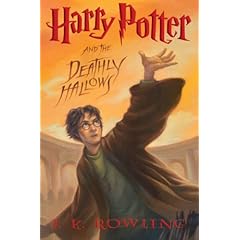
Harry Potter and the Deathly Hallows
by J.K. Rowling

I'll try and go light on the spoilers here, but if you truly don't want to know anything about this book, you should probably skip this review. Heh, "review"... like I'm Roger Ebert or something. This book doesn't need a review. If you've read the first six, you're obviously going to read it. If you haven't read any of them, then you're not going to start with this one. Rowling could have released 759 pages of Harry brushing his teeth, and it would still sell more copies than War and Peace.

A few weeks ago I posted a blog with my predictions about this one. I was right about some things, and I was wrong about some things. Deathly Hallows is definitely the darkest of this series, and has very little of the awe and wonder of the early books. In many ways it reads like a Nazi Holocaust story, with the characters constantly trying to find new places to hide from the evil army. There were parts that were hard to get through, simply because they were drawn out and depressing. But the action scenes are exciting, and the plot is involving. Like most of the HP books, it gets a little convoluted here and there, but everything ties up quite nicely in the end.

Overall, Deathly Hallows is quite good, and the perfect cap for the series. If I were to rank the series, favorite to least favorite, I would say 1, 4, 2, 6, 7, 3, 5. But all of them are excellent books, and easy to read despite the length. In fact, even though this one was one of the harder ones to get through, I still managed to read it in two days.


Icewind Dale: The Crystal Shard
by R.A. Salvatore

I'm halfway through the second book in this trilogy, and so far it's pretty good. The first book, The Crystal Shard, introduces us to Drizzt Do'Urden, one of the most well-known characters in D&D lore. Drizzt is a Drow (that's a dark elf, for you non-gamers), but he's a good guy, which is rare for a Drow. Which of course, means he's an outcast - his own people think he's too nice, and other races think all dark elves are evil. Drizzt is the ultimate "fan service" character, the kind of hero Todd McFarlane would design if he wrote novels instead of comics. There is absolutely nothing about this character that isn't "cool". He fights with a pair of scimitars, he can summon a black panther, he can hide like a ninja, he knows magic, and he's nearly untouchable in battle. Even his weaknesses are badass: he's allergic to sunlight, and he's a social outcast; so he stays in the shadows and wears concealing hoods. This is exactly the kind of "ultimate" character you would design if you were a twelve-year-old boy.

That said, the book is surprisingly absorbing. Salvatore, who some might remember for killing a major Star Wars character in Vector Prime, is actually a pretty good writer. I didn't care for his Star Wars writing at the time, but here he seems to be more in his element. I think he has more freedom here, even within the boundries of D&D's strict rulebooks, because he's using his own characters. While Drizzt is obviously Salvatore's favorite, the other characters get plenty of time to shine. They aren't nearly as deep as Drizzt (a couple of them feel like they walked right off a standard Character Sheet), but they have their moments. I do wish the book had a stronger female presence, though. The only major female character, Catti-Brie, gets very little screen time. I hope she has a larger role later in the trilogy.

If you've been wanting to try any books set in the D&D universe, I would definitely start with this one.


Cell
by Stephen King

Stephen King does zombie horror. Except they're not zombies. And it's another post-apocalyptic story, like The Stand. Except this is nothing like The Stand. Well, whatever it is, this is a really good book about the last few sane people in a world gone mad. This is one of those books that just jumps right into the story, hooking you after just a few pages, and becomes hard to put down. I thought the ending was a little weak, but the journey was still worth it. This is one of my favorite Stephen King books.


Lisey's Story
by Stephen King

This is NOT one of my favorite Stephen King books, but it wasn't bad. I can't tell you much about the plot without spoiling it, so this is going to be pretty vague: The main character is the widow of a famous novelist, and a large portion of the book is her flashbacks of life with her late husband. Like other King books involving novelists (The Dark Half, Misery), King throws a lot of himself into this book. It doesn't get interesting until about halfway through, so if you start it, stick with it. It took a lot of work to get to the good parts of this book, and I can't promise that the payoff is worth it. Overall, I am glad I read it, but I can't really recommend it.


The Dragonlance Chronicles
(Dragons of Autumn Twilight, Dragons of Winter Night, and Dragons of Spring Dawning)
by Margaret Weis & Tracy Hickman

I read these because they are some of the earliest novels that take place in the D&D universe. The characters introduced are well-known to gamers, and therefore these are books you're simply "supposed to have read" if you're in the gaming crowd. Standard fantasy fare; filled with dwarves and elves, monsters and magic, dungeons and, well, dragons. Let's call it "Tolkein For Dummies", since the elements are similar, but it's much easier to read. I enjoyed them, but they aren't particularly memorable.


She's Not There: A Life In Two Genders
by Jennifer Finney Boylan

This is the autobiography of a trangender college professor. Boylan is an excellent writer, and was already a published author even before she realized she was a woman. It's both thought-provoking and funny, with a quirky sense of humor punctuating the drama. This is one of two books I generally recommend anyone who is interested in learning more about the subject, the other being True Selves. True Selves is more informative; this one is more entertaining.


Religion Gone Bad
by Mel White

One of the few non-fiction books I've read by choice, this is a report on the war between Christian fundamentalism and gay rights. Much of the book is an attack on Jerry Falwell, who ironically died shortly after this book was published... kind of making it obsolete. But Falwell's associates still spread the same message, so the book is still relevant. It was written by a gay preacher, who was once a fundie himself before he saw the light. Pastor Mel White still preaches the word of God, but without the bigotry inherent in the sermons of fundies like Pat Roberson. If even half of what this book says is true (and with the extensive footnotes and bibliography, I don't think White made anything up), then I fear greatly for the future. Our current president has committed some serious crimes with regards to seperation of church and state; more than most people know. After reading this book, I'd have to say that if there is a Hell, Jerry Falwell is roasting in it as we speak. But that's just my opinion.

Wednesday, June 06, 2007

My Harry Potter Predictions

Warning: This blog assumes you have read the first six books, and may contain spoilers.

I only have a couple of iron-clad predictions for the next Harry Potter book: It will make bazillions of dollars, and someone's going to spoil the ending for me before I manage to finish reading it. Beyond that, your guess is really as good as mine. However, here's a few Q&As that have been buzzing around my head:


Is Harry going to die?
It certainly looks like he is, which is exactly why I think he won't. So many people are worried about Harry's fate in the upcoming book. By now, anyone who's read the sixth book (The Half-Blood Prince) has pondered whether Harry is a horcrux. When Voldemort zapped baby Harry, he was transferring part of himself into the kid. That's also why Voldy hasn't been able to kill him, because doing so would kill Voldemort himself. Sure, Dumbledore told Harry that he was protected by hi Mother's love or some crap, but that was so Harry wouldn't find out he was a horcrux. In Book 6 it was revealed that Harry has to find and destroy all the horcruxes in order to be rid of Voldemort forever. So it really looks like the only way to kill Voldemort is to kill Harry Potter.

But the fact that people already see this, is what tells me it won't happen. When I read the first book, I was sure Snape was the one trying to steal the Sorceror's Stone. There was so much foreshadowing, that it had to be true. Yeah, it could have been a red herring, but I knew it was a children's book, so it wouldn't be that deep. And yet it was. I think Rowling is once again trying to trick us. There are so many people out there who already think they know how Book 7 is going to end, that it can't possibly end that way.

My guess is that sometime in the first half of Book 7, Harry is going to figure out that he's a horcrux. He's going to go through the rest of the book believing he's going to have to die in order to kill Voldemort. Then, at the end, there's going to be a twist that allows him to live.

One more thing: I've heard several people say, "Harry's death is the only way it can end." Then they'll go on about things like honor, duty, a boy becoming a man and realizing that he has to sacrifice himself to save everyone else, yada yada yada. I don't care how it's presented, killing Harry would be a piss-poor way to end the series. I have really enjoyed the series so far, and I have to believe that I'm going to enjoy Book 7 as well. I believe that overall, I'm going to have a great impression of the series, and I'll want to read all seven again someday. But if Harry dies, I probably won't like the series as much. Therefore, the boy will live. I know that's not exactly logical reasoning, but that's what I believe.


Is Dumbledore really dead?
When the fifth book (Order of the Phoenix) was on its way out, Rowling announced that someone was going to die in it. When I got to the book's climax, I knew someone was going to die soon. But when I read the death scene itself, I said, "Was that it?" That's the scene that made Rowling says made her cry when she wrote it? Sirius Black didn't die, he fell through a door. What a freaking cop-out. She could bring him back any time she feels like it. In a magical world, a true death scene requires things like, I don't know, a BODY. I mean, look at Peter Pettigrew. They assumed he'd been disintegrated when they found his finger.

But Dumbledore's case is a little different. They found a body, plus his picture was in the painting. But I'm still a little suspicious. For starters, the way it happened - Snape shoots Dumbledore, Dumbledore falls over the edge. Later they find his body on the ground. When I read it, my first thought was, "That's when they pulled the switch". What kind of switch, I don't know. Maybe Dumbledore zapped himself into the painting. But for some reason I have doubts regarding whethert it was actually Dumbledore's body they found on the ground.

Maybe Dumbledore will be back in the next book. Maybe he'll appear towards the end, just in time to tell Harry how to kill Voldy without dying himself. Maybe Dumbledore will even die again at the end of Book 7, sacrificing himself to save Harry. Or not. I don't know.

Book 7 is going to be so different from the others. The first six were so formulaic - they start with Harry at the Dursley's house, then he goes to school, it goes through the entire school year, then he goes back to the Dursleys. Dumbledore is also a strong part of the formula. He's like a Dungeonmaster, indirectly guiding Harry through his adventures, giving Harry hints and accomplishing through Harry what he can't do himself, then explaining it all at the end of the book. But with Harry not going back to Hogwarts, and no Dumbledore to guide him, and Harry having grown up so much by now, this book is going to break the formula all kinds of ways. Which makes it much harder to predict.


Is Snape really a bad guy?
The best I can say, is that there's still more to Snape than meets the eye. I know, "Duh." Rowling fooled us in the first book, it wouldn't be unlike her to do it again. Potter fans are quick to point out that in Book 6, when Snape is about to kill Dumbledore, the headmaster's pleas are sort of ambiguous. Is Dumbledore pleading for Snape not to kill him? Highly doubtful, that just doesn't sound like him. The way the scene plays out, it's almost as if Dumbledore and Snape had some sort of plan, and "killing" Dumbledore was part of the plan.


So who will die in Book 7?
Beats me. I really hope that Harry, Ron, Hermione, and Ginny stay alive. If one of them does die, my money's on Ron. On the other hand, Rowling did a lot of pushing characters together in the sixth book. The whole Harry/Ginny thing seemed a little rushed and/or forced. I can't help but wonder if Rowling needed one more emotional card to play in Book 7, one more potential tragedy for Harry to overcome before the final battle.


Will there ever be another Harry Potter Book?
Rowling has made it very clear that this is meant to be a seven-book series. However, this is also the first thing she's ever written. She doesn't know a damn thing about the curses from which writers suffer. Often you think a story is over and done with, and then your brain starts imagining further scenerios for your characters. Eventually you can't stop obsessing until you write them down. I have no doubt Rowling will take a nice long break from the Potterverse after Book 7 hits the shelves. Maybe she'll start spending more time with her family, or maybe she'll start writing something else. But sooner or later she's going to get the itch to revisit Harry's world. Maybe she'll give in to the temptation, maybe she won't.